Does your disability qualify you for NDIS-funded cleaning?
If your disability makes cleaning genuinely difficult or unsafe (not just inconvenient), you likely qualify.
Three Qualifying Barrier Categories:
- Physical — Balance issues, chronic pain/fatigue, limited strength (e.g., cerebral palsy, fibromyalgia, MS, spinal injuries)
- Cognitive — Executive function problems, memory issues, decision-making difficulties (e.g., brain injury, ADHD, autism, dementia)
- Psychosocial — Anxiety disorders, depression, OCD, PTSD that prevent household management
What WON’T qualify:
- Being busy with work
- Hating cleaning
- Preferring hobbies over chores
- General life stress
Self-Assessment Checklist (need 4+ to likely qualify):
- Documented disability diagnosis
- Specific functional barriers (not preference)
- You’ve tried managing independently
- Cleaning impacts goals or safety
- Alternative solutions haven’t worked
- Support would meaningfully improve your situation
Key to Approval: Document specific disability-related barriers with professional assessment (OT report recommended). Show how cleaning impacts safety, health, or NDIS goals — not just that it’s inconvenient.
Next Step: Contact support coordinator or Humming Home Services for eligibility consultation.
The Question Everyone Asks (But Nobody Answers Clearly)
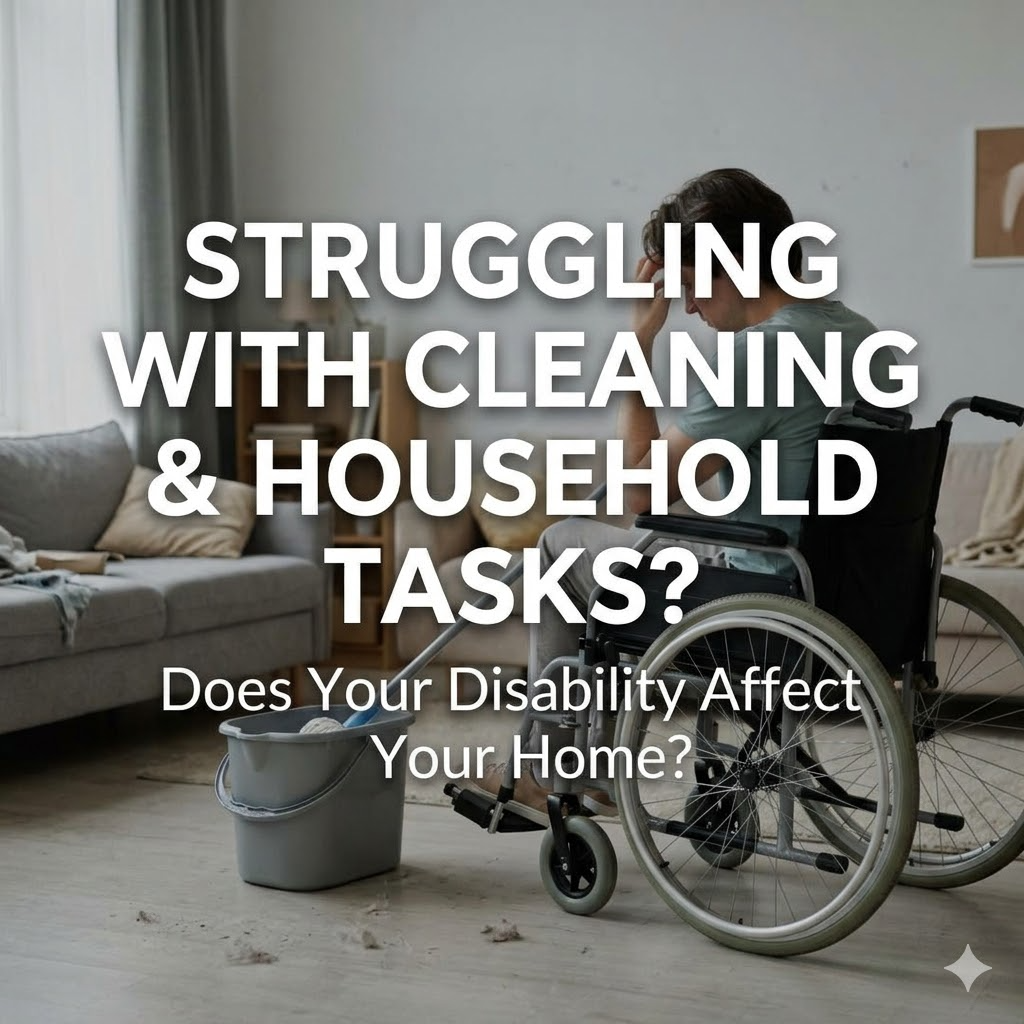
Over my years working with NDIS participants and their families, I’ve heard this question more times than I can count:
“Does my disability actually qualify me for funded cleaning?”
People ask it nervously, almost apologetically. Like they’re worried the answer will be “no, you don’t deserve this.”
Here’s what I want to say upfront: If your disability makes it genuinely difficult or unsafe to manage your household, you likely qualify. The NDIS wasn’t designed for people who are lazy. It was designed for people whose disability creates barriers.
The problem is, understanding NDIS eligibility isn’t straightforward. You need to know:
- What the NDIA actually looks for
- Which disabilities typically qualify
- What barriers count vs. which don’t
- How to know if your specific situation meets the bar
That’s what this post breaks down. By the end, you’ll know whether cleaning support is realistic for you and what you need to prove it.
Understanding NDIS “Reasonable and Necessary”
Before we talk about specific disabilities, let’s talk about the framework the NDIA uses.
The NDIS doesn’t fund a support just because you want it. They fund supports that are:
- Reasonable — Is this a proportionate use of funding given the person’s goals and overall plan?
- Necessary — Does the person have a documented disability-related barrier that makes this task genuinely difficult or unsafe?
For household cleaning specifically, “reasonable and necessary” means:
✓ Your disability creates a functional barrier with household tasks
✓ You’ve attempted to manage it independently (or documented why you can’t)
✓ The support helps you achieve your NDIS goals
✓ The support is proportional to your needs
What it doesn’t mean:
✗ You’re just not good at cleaning
✗ You prefer to outsource household tasks
✗ You’re busy with work and want someone else to do your chores
✗ You want a luxury cleaning service
The distinction matters. The NDIA looks at disability-related impact, not personal preference.
If your disability doesn’t create the barrier, funding isn’t appropriate. And the NDIA will push back.
The Three Categories of Barriers That Qualify for Funded Cleaning
When the NDIA evaluates whether you need cleaning support, they’re looking for barriers in three main areas. Let’s break each down.
Category 1: Physical Barriers
What this means: Your disability affects your physical capacity to perform household tasks.
Specific conditions that typically qualify:
Balance & Fall Risk
- Cerebral palsy affecting balance
- Spinal cord injury
- Parkinson’s disease
- Stroke with residual mobility effects
- Inner ear conditions causing vertigo
Why it qualifies: These conditions make cleaning unsafe. Reaching, bending, standing for extended periods, and managing wet floors create genuine fall risk. The NDIA sees this as a safety issue, not a preference issue.
Example the NDIA wants to see: “Participant has balance impairment from spinal cord injury. Reaching for cleaning supplies or standing on unstable flooring during cleaning poses fall risk. Participant has experienced 2 falls in the past 6 months related to household management.”
Chronic Pain & Fatigue
- Chronic fatigue syndrome (CFS/ME)
- Fibromyalgia
- Long COVID (especially if causing post-exertional malaise)
- Rheumatoid arthritis
- Lupus
- Multiple sclerosis (progressive types)
Why it qualifies: These conditions limit sustained physical activity. Cleaning requires repetitive motion and prolonged standing—both exacerbate pain and fatigue. If cleaning causes significant symptom flare-ups, that’s a documented barrier.
Example the NDIA wants to see: “Participant has chronic fatigue syndrome with documented post-exertional malaise. After 2-3 hours of household activity, participant experiences severe fatigue requiring 24-48 hour recovery period. This impact is predictable and documented. Cleaning activities trigger this pattern.”
Limited Strength & Dexterity
- Muscular dystrophy
- Motor neurone disease
- Cerebral palsy (affecting limb control)
- Severe arthritis
- Post-stroke weakness
Why it qualifies: If you can’t safely operate cleaning equipment or manage physical demands, that’s a functional barrier. The NDIA funds support when the task itself becomes unsafe or impossible.
Example the NDIA wants to see: “Participant has reduced grip strength from MND affecting both hands. Participant cannot safely operate vacuum cleaner or hold mop for duration required. Attempts to clean result in dropped equipment and incomplete cleaning due to fatigue.”
Category 2: Cognitive Barriers
What this means: Your disability affects your ability to organize, initiate, or execute household cleaning tasks.
Specific conditions that typically qualify:
Executive Function & Planning Challenges
- Acquired brain injury
- Traumatic brain injury (TBI)
- ADHD (when affecting executive function significantly)
- Autism spectrum disorder (when executive function is impacted)
- Progressive dementia
- Intellectual disability
Why it qualifies: Cleaning isn’t just a physical task—it requires planning, sequencing steps, organizing materials, and executing a complex multi-step process. If your disability affects these executive functions, you have a legitimate barrier.
Example the NDIA wants to see: “Participant has acquired brain injury affecting executive function. Participant struggles with task initiation and sequencing. Participant intellectually understands cleaning needs but cannot organize or begin the task independently. Without structure and support, cleaning does not occur.”
Memory & Cognitive Processing
- Dementia (early-stage)
- Traumatic brain injury with memory impact
- Stroke affecting cognition
- Severe ADHD affecting working memory
- Progressive neurological conditions
Why it qualifies: If you can’t remember or process cleaning tasks, that’s a cognitive barrier. You may want to clean but can’t execute due to cognitive limitations.
Example the NDIA wants to see: “Participant has early-stage dementia. Participant experiences memory loss affecting ability to maintain household routines. Participant has left stovetop on multiple times due to memory gaps. Professional cleaning support reduces health & safety risks associated to cognitive barriers.”
Decision-Making & Mental Capacity
- Severe mental illness affecting capacity (psychosis, severe depression)
- Autism affecting sensory processing and decision-making
- Intellectual disability affecting independent decision-making
Why it qualifies: Some disabilities affect your ability to make decisions or initiate action. If mental health or cognitive barriers prevent you from maintaining your home, that’s legitimate.
Example the NDIA wants to see: “Participant has severe depression with anhedonia affecting motivation and capacity for self-care activities. During depressive episodes, household management becomes impossible. Participant experiences avoidance and overwhelm around environmental clutter, which exacerbates symptoms.”
Category 3: Psychosocial Barriers
What this means: Your disability affects your mental health, emotional regulation, or psychological capacity in ways that impact household management.
Specific conditions that typically qualify:
Anxiety Disorders
- Generalized anxiety disorder
- Agoraphobia
- OCD (especially if contamination fears or compulsions affect cleaning)
- PTSD with avoidance behaviors
- Panic disorder affecting capacity for self-care
Why it qualifies: If anxiety prevents you from completing household tasks—through avoidance, panic, or compulsive patterns—that’s a psychosocial barrier. It’s disability-related, not preference-related.
Example the NDIA wants to see: “Participant has severe contamination-related OCD. Environmental clutter and dust trigger contamination fears and compulsions. Attempts to manage cleaning environment result in panic attacks and avoidance behaviors. Professional cleaning support reduces anxiety triggers and allows participant to engage in other activities.”
Depression & Motivation
- Clinical depression with anhedonia
- Persistent depressive disorder
- Bipolar disorder (depressive episodes)
- Treatment-resistant depression
Why it qualifies: Depression affects motivation, energy, and capacity for self-care. This isn’t laziness—it’s a symptom. If depression prevents you from maintaining your home safely, that’s a documented barrier.
Example the NDIA wants to see: “Participant has treatment-resistant depression affecting motivation and self-care capacity. During lower mood periods, household management becomes impossible. Participant lacks energy and motivation to initiate cleaning tasks. Without support, environmental conditions deteriorate, affecting participant’s mental health further.”
Social & Emotional Barriers
- Autism spectrum disorder (if sensory or social factors affect home management)
- Intellectual disability affecting independent living
- Complex PTSD affecting trust and capacity
- Personality disorders affecting self-care
Why it qualifies: Some disabilities create barriers that are psychosocial in nature. If your disability makes it genuinely hard to manage your home for psychological reasons, that counts.
Example the NDIA wants to see: “Participant is autistic with significant sensory sensitivities. Auditory and tactile sensations involved in cleaning (vacuum noise, wet hands, dust) cause sensory overload. Participant avoids cleaning to prevent overload. Professional support addresses this barrier.”
The Combination Effect: When Multiple Barriers Create Eligibility
Here’s something important: You don’t need to fit neatly into one category.
Most real people have multiple barriers working together.
For example:
- Chronic pain + depression + anxiety
- Brain injury + fatigue + executive function challenges
- Autism + ADHD + sensory sensitivities
When barriers stack, eligibility becomes clearer. The NDIA sees multiple reinforcing barriers and recognizes this is a genuine, complex need.
Do You Qualify? The Self-Assessment Checklist
Use this to evaluate whether you likely qualify:
✓ You have a documented disability (diagnosed, not suspected)
✓ Your disability creates specific functional barriers (not just preference)
✓ You’ve attempted to manage cleaning independently (and documented the struggle)
✓ Cleaning impacts your goals or safety (blocks work, causes pain flares, triggers mental health crisis, poses safety risk)
✓ Alternative solutions haven’t worked or aren’t feasible (you can’t rely on family, can’t manage alone, accommodations don’t help enough)
✓ Professional cleaning support would meaningfully improve your situation (frees up capacity for goals, reduces symptom triggers, improves safety)
If you checked 4+ of these, you likely qualify. If you checked all 6? You probably definitely qualify.
What WON’T Qualify You (And Why)
Let me be direct about what the NDIA won’t fund:
❌ “I’m just busy with work” — Busy ≠ disability barrier. Plenty of employed people clean their own homes.
❌ “I hate cleaning” — Preference ≠ disability barrier. The NDIA isn’t there to eliminate tasks you dislike.
❌ “I’d rather spend time on hobbies” — Personal priority ≠ disability barrier. Your time is valuable, but that’s not why NDIS exists.
❌ “My house is really messy” — Messiness alone isn’t a barrier. The barrier is why it’s messy. Is it because your disability prevents you from cleaning? Then yes. Is it because you procrastinate? No.
❌ “General life stress” — Stress from work, relationships, or circumstances doesn’t qualify. Disability-related impact does.
The distinction: NDIS funds supports that address disability-related barriers, not general life inconveniences.
If your barrier isn’t rooted in your disability, the NDIA will likely say no. And they’ll be right to do so.
How the NDIA Actually Evaluates Your Eligibility
When you apply for cleaning support, here’s how the NDIA assesses it:
Step 1: Disability Confirmation
They verify you have a diagnosed disability that’s on the NDIS disability list. (Most common disabilities qualify, but check the official NDIS disability list to be sure.)
Step 2: Functional Impact Assessment
They evaluate how your disability specifically affects your ability to perform household tasks. This usually comes from:
- Your occupational therapist assessment
- Medical documentation
- Support coordinator observation
- Your own detailed explanation
Step 3: Safety & Necessity Determination
They assess: Is cleaning support necessary for safety, health, or goal achievement? Does the funding requested match the documented need?
Step 4: Proportionality Check
They ask: Is this a reasonable use of plan funding given your overall situation?
The key: Documentation matters. The NDIA relies on professional assessments and specific examples, not general statements.
Weak example: “I need help with cleaning because I have depression.”
Strong example: “I have treatment-resistant depression. During depressive episodes (which occur 3-4 weeks per month), I lack motivation for household tasks. My environment deteriorates, which exacerbates depressive symptoms. My psychiatrist has documented this pattern. Occupational therapist assessment shows I require 4 hours weekly professional support during these episodes.”
See the difference? One is vague. One is documented, specific, and compelling.
Real-World Scenarios: Do These Qualify?
Scenario #1: Sarah, Age 34, Fibromyalgia
Sarah has fibromyalgia causing widespread pain and fatigue. She works part-time. After 4 hours of work, she has minimal energy. She attempts light cleaning on weekends; this triggers pain flares lasting 2-3 days, forcing her to take time off work.
Does she qualify? YES. Her disability directly creates a barrier (pain flares from activity). Cleaning triggers documented, predictable symptom exacerbation. This impacts her employment goal.
Scenario #2: Marcus, Age 28, ADHD
Marcus has ADHD affecting executive function. He struggles with task initiation and organization. His apartment is cluttered. He finds it hard to start cleaning, but when he does, he manages okay.
Does he qualify? MAYBE. The barrier is real (executive function), but if Marcus can manage cleaning with structure/reminders, the NDIA might recommend accommodations (visual checklists, timers) before funding professional support. If accommodations have been tried and don’t work, then yes.
Scenario #3: Priya, Age 52, Chronic Pain + Severe Anxiety
Priya has rheumatoid arthritis causing chronic pain. She also has contamination-related OCD. Touching cleaning supplies triggers compulsive behaviors and anxiety. The physical pain + psychological barriers mean she cannot safely or independently manage cleaning.
Does she qualify? YES, absolutely. Multiple reinforcing barriers (physical + psychological). Both documented. Both create genuine, disability-related obstacles.
Scenario #4: James, Age 41, Employed, Wants Convenience
James works 50+ hours per week as a lawyer. He’s healthy but wants someone else to clean because he’s busy and would rather spend weekends on hobbies.
Does he qualify? NO. His barrier is preference, not disability. The NDIA doesn’t fund lifestyle convenience.
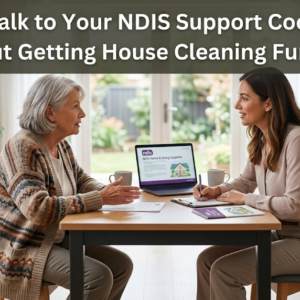
The Conversation With Your Support Coordinator: What to Lead With
Once you’ve assessed that you likely qualify, how do you present it to your SC?
Lead with your specific, disability-related barriers, not with the request.
❌ Don’t lead with: “I need cleaning support because my house is messy.”
✅ Do lead with: “My [disability] creates barriers with household tasks that I want to discuss. When I attempt cleaning, I experience [specific impact: pain flares / anxiety spikes / symptom exacerbation]. This impacts my ability to [work / manage my health / maintain independence]. I’m wondering if my plan can address this barrier.”
The NDIA listens when you speak their language: disability barriers, functional impact, goal connection.
Get Professional Assessment (It Strengthens Your Case)
Here’s the reality: If you want to maximize approval likelihood, get an occupational therapist assessment that documents your cleaning barriers.
An OT can provide:
- Professional evaluation of your functional capacity
- Specific documentation of barriers
- Formal recommendation for support hours
- Written report the NDIA respects
This transforms your eligibility from “participant says they need help” to “qualified professional has assessed and recommended support.”
Cost: Usually $300-600
Result: Much higher likelihood of approval
Common Eligibility Questions: Answered
“If I manage cleaning sometimes, do I still qualify?”
Yes. It’s about consistency and cost. If you can manage cleaning but it:
- Requires massive energy/recovery time
- Causes pain flares or symptom exacerbation
- Takes time you need for work/goals
- Happens unpredictably
…then inconsistent capacity doesn’t disqualify you. You still have a barrier.
“Do I need to be completely unable to clean to qualify?”
No. You need a documented barrier, not total incapacity. If cleaning is unsafe, causes harm, or prevents you from achieving goals, that’s qualification-worthy.
“What if I have multiple disabilities? Does that help?”
Sometimes. Multiple barriers can strengthen your case because they compound. But the NDIA evaluates each barrier specifically—don’t just list diagnoses. Explain how each one impacts cleaning.
“Will the NDIA deny me if my condition is ‘mild’?”
Not necessarily. Severity isn’t the only factor. Impact matters. A “mild” disability that significantly affects your goals can qualify. A “severe” diagnosis that doesn’t affect household capacity might not.
“Do I need to be on disability payments to qualify?”
No. NDIS eligibility is separate from government disability payments. You can be employed and still qualify for NDIS support.
Red Flags: When Eligibility Might Be Questioned
If your situation includes these, expect the NDIA to ask more questions:
🚩 No professional documentation — You claim barriers but no GP/specialist has documented them
🚩 No previous attempts — You haven’t actually tried managing cleaning; you’re just asking preemptively
🚩 Inconsistent narrative — You say you can’t clean but your support coordinator notes you manage other physical tasks fine
🚩 Preference language — You frame it as “I’d prefer not to clean” instead of “my disability prevents me from cleaning safely”
🚩 No impact on goals — You can’t connect cleaning barriers to any NDIS goals
If any of these apply, expect more scrutiny. Address them proactively.
The Bottom Line: Do You Qualify?
If your disability creates specific barriers with household tasks—barriers that affect your safety, health, or ability to achieve your goals—then yes, you likely qualify.
The NDIA isn’t trying to deny people. They’re trying to fund supports that address disability-related needs.
Your job is to clearly articulate:
- What your disability is (diagnosed, documented)
- How it specifically affects cleaning (physical, cognitive, or psychosocial barrier)
- What impact this has (safety, health, goal achievement)
- Why alternatives don’t work (you’ve tried, it’s not feasible, etc.)
Do that, and eligibility approval becomes likely.
Ready to Move Forward? We’re Here to Help
If you’ve assessed that you likely qualify or you’re still uncertain and want to explore that’s where Humming Home Services comes in.
We’ve worked with hundreds of NDIS participants. We understand eligibility barriers. We know what documentation the NDIA needs. And we can help you navigate the process.
What we offer:
✓ Free eligibility consultation — Tell us about your situation; we’ll give honest feedback on whether cleaning support is likely viable
✓ NDIS navigation support — We’ve worked with support coordinators for years. We understand the system.
✓ Professional cleaning — Once approved, we deliver reliable, disability-informed cleaning that respects your needs
✓ Direct SC communication — We handle all coordination with your support coordinator and NDIA
You don’t have to figure this out alone. We work with people every day who weren’t sure if they qualified. Many did. Some didn’t. But they all knew where they stood.
[Book Your Free Eligibility Consultation] with Humming Home Services, or [call us: XXX] to discuss your specific situation.
No pressure. No sales pitch. Just honest conversation about whether NDIS-funded cleaning is realistic for you.
Final Thoughts
The NDIS was created to support people whose disability creates barriers. If your disability is creating a barrier with household management, you’re exactly who this system was designed to help.
The question isn’t whether you “deserve” it or whether it’s “fair” to others. The question is: Does your disability create a functional barrier with this task?
If yes, then you qualify.
Now it’s about getting the documentation and support to prove it.
We’re here when you’re ready.
Have questions about your specific eligibility? Drop them in the comments. Or reach out directly, we’re happy to help you figure out where you stand.
Humming Home Services: Supporting NDIS participants with disability-informed cleaning and navigation support.