Cleaning Toowoomba ph

NDIS Gardening Providers in Brisbane, Toowoomba & Sunshine Coast: The Complete Authority Guide.

NDIS Core Supports • Queensland Guide

NDIS Gardening Providers in Brisbane, Toowoomba & Sunshine Coast: The Complete Authority Guide

Region: Greater Brisbane, Toowoomba & Sunshine Coast Funding Line: 01_019_0120_1_1 (Household Tasks) Read Time: 8 Mins

💡 Executive Summary for Participants & Support Coordinators:

  • 100% Core Funded: Yard maintenance is supported under Assistance with Daily Life (Line Item 01_019_0120_1_1) when functional impairments prevent independent upkeep.
  • Zero Out-of-Pocket on Price-Capped Plans: Rates strictly align with NDIA price caps for Self-Managed, Plan-Managed, and Agency-Managed participants.
  • Climate-Specific Schedules: Subtropical summer growth surges in Brisbane, winter frost in Toowoomba, and coastal rainfall on the Sunshine Coast require customized visit schedules.

Maintaining a safe, accessible, and enjoyable outdoor space is vital for physical well-being, home accessibility, and overall independence. For National Disability Insurance Scheme (NDIS) participants across South East Queensland and the Darling Downs, regular yard maintenance is not just about aesthetics—it is an essential health, safety, and mobility requirement.

Overgrown lawns, obstructed walkways, trailing branches, and uneven garden beds can create significant trip hazards and prevent participants, support workers, and mobility aids from safely navigating home environments. This comprehensive guide details how NDIS gardening funding operates, eligible services, regional yard care nuances across Brisbane, Toowoomba, and the Sunshine Coast, and how to engage an experienced, compliant provider.


1. How NDIS Funding for Gardening and Yard Maintenance Works

Gardening and outdoor home maintenance are funded under specific criteria established by the National Disability Insurance Agency (NDIA). Understanding where these funds sit within your plan ensures smooth service delivery without billing complications.

The Relevant Budget Category

  • Support Category: 01 – Assistance with Daily Life
  • Line Item Code: 01_019_0120_1_1 (House Cleaning And Other Household Activities)
  • Item Description: Practical assistance with domestic chores and yard maintenance where functional limitations prevent the participant from completing tasks independently.

The "Reasonable and Necessary" Benchmark

  1. Directly Linked to Disability: The participant cannot safely maintain the property due to physical, cognitive, or sensory impairments.
  2. Value for Money: The cost complies strictly with current NDIS Pricing Arrangements and Price Limits.
  3. Not an Everyday Living Cost: The funding directly addresses barriers caused by the disability rather than general luxury landscaping or decorative improvements.

Plan Management Compatibility

  • Self-Managed: You can engage any professional gardening provider, negotiate rates, and pay invoices directly before claiming reimbursement via the myplace portal.
  • Plan-Managed: You can engage registered or unregistered contractors. The provider sends invoices directly to your Plan Manager for prompt processing.
  • NDIA-Managed (Agency-Managed): You must engage an NDIA-Registered provider who submits claims directly through the NDIS portal.

2. Core Gardening & Yard Maintenance Services Covered

Professional NDIS gardening specialists deliver structured, routine care tailored to the individual access requirements of each home:

Service Area Key Activities Included Accessibility & Safety Impact
Lawn Mowing & Edging Precision turf cutting, line trimming along fences, clipping clean-up Eliminates uneven terrain and prevents trip/fall hazards.
Walkway & Ramp Clearance Pruning low-hanging branches, trimming encroaching hedges Ensures wheelchair, walker, and emergency service access.
Weed Management & Mulching Targeted weeding, non-toxic weed control, mulch spreading Inhibits pest habitats and prevents rapid weed overgrowth.
Green Waste Removal Comprehensive raking, blowing, bagging, and council disposal Keeps yards tidy, clean, and free of decomposing debris.
Seasonal Hazard Reduction Gutter clearing, storm debris cleanup, leaf litter removal Mitigates fire and flood risks during Queensland storm seasons.

3. Regional Yard Care Demands Across Queensland

Brisbane (Metropolitan, North & South Suburbs)

  • Climate Characteristics: Subtropical heat, high summer humidity, and sudden storm bursts.
  • Key Yard Challenges: Fast-growing warm-season grasses (Couch, Kikuyu, Buffalo) requiring high-frequency mowing from October through April.
  • Access Considerations: Smaller suburban blocks, multi-level properties, and side-access passages that require specialized compact equipment.

Toowoomba & The Darling Downs

  • Climate Characteristics: Higher elevation, distinct four-season climate with freezing winter mornings and dry autumns.
  • Key Yard Challenges: Rapid deciduous leaf accumulation in autumn, frost-sensitive shrubs in winter, and sloped volcanic soil terrain.
  • Access Considerations: Larger residential allotments requiring robust sloping terrain management, windbreak hedging, and gutter protection from heavy eucalypt debris.

Sunshine Coast (Coastal Strip to Hinterland)

  • Climate Characteristics: Maritime coastal humidity along Caloundra, Maroochydore, and Noosa; heavy seasonal rainfall across the Blackall Range hinterland (Maleny, Montville).
  • Key Yard Challenges: Rapid weed germination, salt-spray tolerant turf management, and lush tropical foliage requiring frequent trimming.
  • Access Considerations: Acreage properties, steep driveways, and moisture-prone paths requiring pressure cleaning and traction maintenance.

4. What Sets an Authority NDIS Gardening Provider Apart?

  1. Worker Screening & Safety Compliance: All field personnel hold verified NDIS Worker Screening Checks, National Police Clearances, and relevant working-with-children credentials.
  2. Transparent, NDIS-Capped Pricing: Rates strictly aligned with the NDIS Price Guide with zero surprise charges or unapproved travel surcharges.
  3. Person-Centered Communication: Respectful, quiet, and predictable service schedules with advance notifications for participants sensitive to loud equipment or routine disruptions.
  4. Detailed Invoicing: Invoices clearly display the participant's name, NDIS number, date of service, exact line item code, hours worked, and task breakdown for swift Plan Manager approval.
  5. Full Commercial Liability Insurance: Comprehensive coverage protecting property assets, fences, and outdoor facilities.

5. Step-by-Step: How to Book Your NDIS Gardening Service

  1. Initial Assessment & Quote: Contact the provider with your location, property size, and primary yard maintenance priorities. Specify your plan management type (Self, Plan, or Agency).
  2. Tailored Service Agreement: A clear service agreement is established outlining the scope of work, frequency (e.g., weekly, fortnightly, monthly), hourly rate, and cancellation policy.
  3. First Maintenance Visit: The crew arrives during the agreed window, conducts the required maintenance, safely stows equipment, and clears all debris.
  4. Automated, Stress-Free Invoicing: Invoices are delivered directly to you or your Plan Manager, requiring zero administrative burden from the participant.

6. Frequently Asked Questions (FAQs)

Can my NDIS plan cover regular lawn mowing?

Yes. If you have funding allocated under Core Supports – Assistance with Daily Life, and your disability prevents you from mowing your lawn safely, you can use your funding for regular lawn mowing and edging services.

Do I need a referral from a doctor or occupational therapist?

While not mandatory for every plan, an Occupational Therapist (OT) home assessment report or Support Coordinator recommendation outlining safety risks associated with yard maintenance is valuable during plan reviews to ensure adequate Core funding is allocated.

How often should NDIS gardening visits be scheduled in Queensland?

Due to high summer rainfall and rapid growth, fortnightly visits are recommended between October and April. During the slower winter months (May to September), monthly visits are typically sufficient to keep paths clear and weeds controlled.

Can providers handle one-off overgrown yard clean-ups?

Yes. If a property has become severely overgrown due to an extended hospital stay, transition into a new rental, or provider gap, teams can execute an initial deep clean-up to restore baseline safety before commencing routine upkeep.


7. Partner with Experienced Queensland NDIS Gardening Specialists

Outdoor spaces should be a source of relaxation, comfort, and safety—never a source of stress or physical risk. Whether you are based in the heart of Brisbane, the hills of Toowoomba, or the coastal suburbs of the Sunshine Coast, reliable NDIS gardening ensures your home remains accessible year-round.

📞 Get Started with Your Queensland NDIS Gardening Plan

Serving Greater Brisbane, Toowoomba & Darling Downs, and Sunshine Coast. 100% NDIS Price-Capped with Screened & Insured Staff.

Request an Assessment / Quote

Ready to Find the Right NDIS Cleaning Support?

Whether you are a participant, a Support Coordinator, or a Plan Manager, we are happy to have a straightforward conversation about how Humming can help.

Phone: 0478 534 064 Email: admin@humminghomeservices.au Website: humminghomeservices.au/contact

Cleaning Toowoomba ph

DIY Mould Cleaning Tips for Australian Households

A tidy home does not always require a bigger house.Often, the difference between a cluttered space and an organised home comes down to having the right systems and storage solutions.

Many households accumulate belongings over time, making everyday tasks like cleaning, finding items and maintaining order more difficult.

The good news is that simple organisation changes can create a big improvement.

Whether you live in a family home in Toowoomba, an apartment in Brisbane, or a coastal property on the Sunshine Coast, practical storage solutions can help maximise your space and make your home easier to maintain.

This guide explores 5 smart organisation items that can help create a cleaner, more functional home.

Why Home Organisation Matters

Home organisation is not only about making your house look neat.A well-organised home can help you:

✓ Save time finding everyday items ✓ Reduce unnecessary clutter ✓ Make cleaning easier ✓ Use available space better ✓ Create a calmer living environment When everything has a designated place, maintaining your home becomes much simpler.

Before Buying Storage Items: Declutter FirstOne common mistake is buying storage products before deciding what you actually need.Storage should solve a problem, not become another place to hide clutter.Before organising:
  1. Remove items you no longer use.
  2. Group similar items together.
  3. Identify problem areas.
  4. Measure available space.
  5. Choose storage products that match your needs.

Popular problem areas include:

  • Kitchen cupboards
  • Wardrobes
  • Bathroom cabinets
  • Laundry areas
  • Garages
  • Entryways

Smart Storage Item #2: Storage Baskets and Organiser Boxes

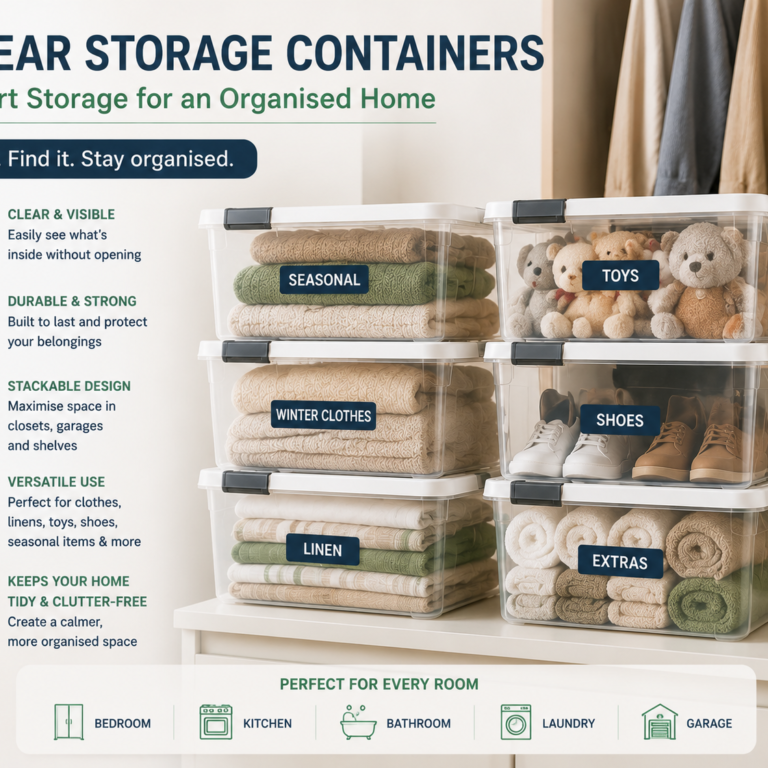
Smart Storage Item #1: Clear Storage Containers

Best For:
  • Wardrobes
  • Garages
  • Linen storage
  • Seasonal items
  • Children’s belongings
Clear storage containers are one of the most useful organisation products because you can easily see what is inside without opening every box.They are ideal for storing:

Winter clothing

  1. Christmas decorations
  2. Toys
  3. Shoes
  4. Extra bedding
  5. Household supplies

Organisation Tip:Add labels even when containers are clear.Labels make it easier for everyone in the household to return items to the correct place.

Where to Find Clear Storage Containers

ToowoombaLook at:

  1. Kmart Grand Central
  2. Bunnings Toowoomba North
  3. Bunnings Toowoomba West

BrisbaneOptions include:

  1. Kmart Chermside
  2. BIG W Chermside
  3. Bunnings Newstead
Sunshine CoastOptions include:
  1. Kmart Sunshine Plaza
  2. BIG W Sunshine Plaza
  3. Bunnings Maroochydore
Best For:
  1. Living rooms
  2. Bathrooms
  3. Bedrooms
  4. Laundry areas
Storage baskets are perfect for keeping frequently used items organised while still looking stylish.They can store:
  1. Towels
  2. Blankets
  3. Toys
  4. Bathroom products
  5. Cleaning supplies
  6. Pet items

A basket system works especially well in family homes because everyone can quickly return items after use.

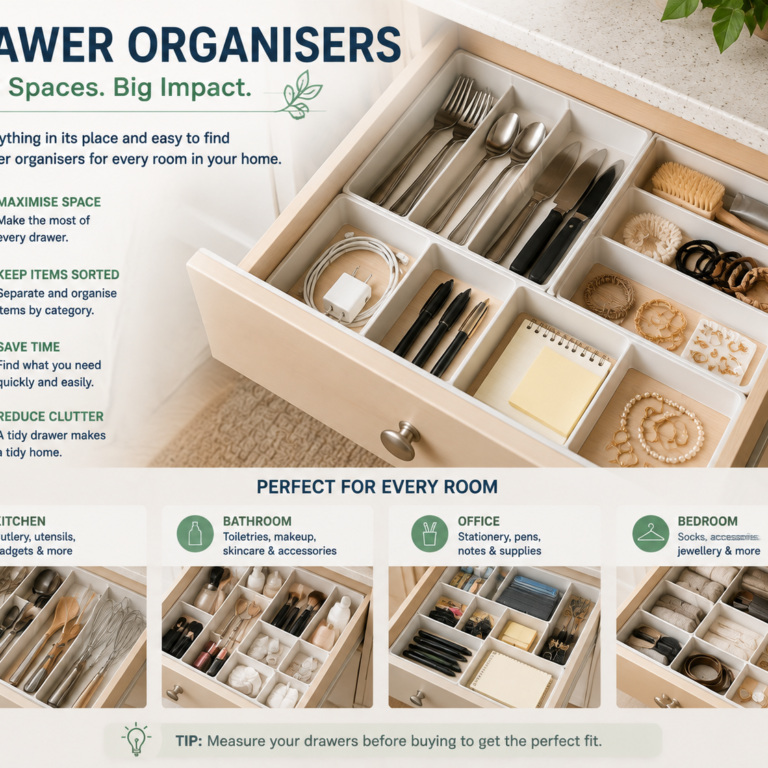
Smart Storage Item #3: Drawer Organisers

Drawers often become clutter zones because small items are difficult to manage.Drawer organisers help divide spaces so everything has a place.

Great for:Kitchen

  • Cutlery
  • Cooking tools
  • Food preparation items

Bathroom

  • Makeup
  • Toiletries
  • Personal care items

Home Office

  • Stationery
  • Cables
  • Small electronics

Smart Storage Item #4: Cleaning Caddy

A cleaning caddy is one of the simplest ways to make cleaning easier.Instead of searching through multiple cupboards, keep your essential cleaning supplies together.A cleaning caddy can hold:
  • Microfibre cloths
  • Surface cleaner
  • Bathroom cleaner
  • Brushes
  • Gloves
  • Sponges
Benefits:
 
✓ Faster cleaning routines
 ✓ Easier room-to-room cleaning 
✓ Less clutter under sinks
This is especially useful for larger homes.

Smart Storage Item #5: Pantry Organization Systems

The kitchen is one of the most important areas to organise because it is used every day.Pantry organisers can include:

  • Clear food containers
  • Stackable shelves
  • Baskets
  • Lazy Susan organisers
  • Labels
Benefits:
  • Easier meal preparation
  • Less food waste
  • Faster grocery shopping
  • Cleaner cupboards
A well-organised pantry helps you see what you already have before buying more.

Best Places to Buy Home Organisation Products in Queensland

KmartBest for affordable:

  • Storage baskets
  • Drawer organisers
  • Containers
  • Pantry storage
  • Home accessories

BIG WUseful for:

  • Storage boxes
  • Household organisation products
  • Laundry storage
  • General home supplies

BunningsBest for:

  • Garage storage
  • Shelving
  • Heavy-duty containers
  • Cleaning equipment
  • Home maintenance storage

Home Organisation Ideas for Different Areas

Kitchen Organisation

Try:
  • Matching containers
  • Drawer dividers
  • Pantry baskets
  • Shelf risers

Bedroom Organisation

Try:
  • Under-bed storage
  • Wardrobe baskets
  • Clothing categories
  • Seasonal storage boxes

Bathroom Organisation

Try:
  • Small baskets
  • Drawer organisers
  • Under-sink storage
  • Product categories

Laundry Organisation

Try:
  • Laundry baskets
  • Cleaning caddies
  • Shelving
  • Product labels

Garage Organisation

Try:
  • Wall hooks
  • Shelving systems
  • Storage tubs
  • Tool organisers

How to Maintain an Organised Home

Organisation is not a one-time project.Simple habits help maintain your results.DailySpend 10 minutes:
  • Returning items
  • Clearing surfaces
  • Resetting rooms
WeeklyReview:
  • Mail
  • Laundry
  • Kitchen clutter
  • Household items
MonthlyOrganise:
  • One drawer
  • One cupboard
  • One storage area

How Professional Cleaning Supports Home Organisation

An organised home is easier to clean, and a clean home is easier to organise.Professional cleaning services can help maintain:
  • Floors
  • Bathrooms
  • Kitchens
  • Living spaces
  • General household cleanliness
For busy families, seniors or people requiring additional support, combining cleaning with home organisation can create a safer and more comfortable living environment.

What are the best home organisation products?

The most useful products are clear storage containers, baskets, drawer organisers, cleaning caddies and pantry storage systems.

Should I declutter before organising?

Yes. Organising items you no longer use creates more clutter rather than solving the problem.

Where can I buy storage organisers in Brisbane?

Storage products are available from retailers including Kmart, BIG W and Bunnings across Brisbane.

How do I keep my home organised?

How do I keep my home organised?Create simple systems, give everything a designated place and complete regular small resets.

Final Thoughts

A more organised home does not require expensive renovations or complicated systems.

Small changes can create a big difference.

Start with one problem area.

Choose storage solutions that fit your lifestyle.Create simple habits that everyone in the household can follow.Whether you are organising a home in Toowoomba, Brisbane or the Sunshine Coast, the right storage solutions can help create a cleaner, calmer and more enjoyable space.

Keep it clean. Keep it tidy and well organised. Keep your home humming. Get started with Humming Home Services.

Ready to Find the Right NDIS Cleaning Support?

Whether you are a participant, a Support Coordinator, or a Plan Manager, we are happy to have a straightforward conversation about how Humming can help.

Phone: 0478 534 064 Email: admin@humminghomeservices.au Website: humminghomeservices.au/contact
40.webp

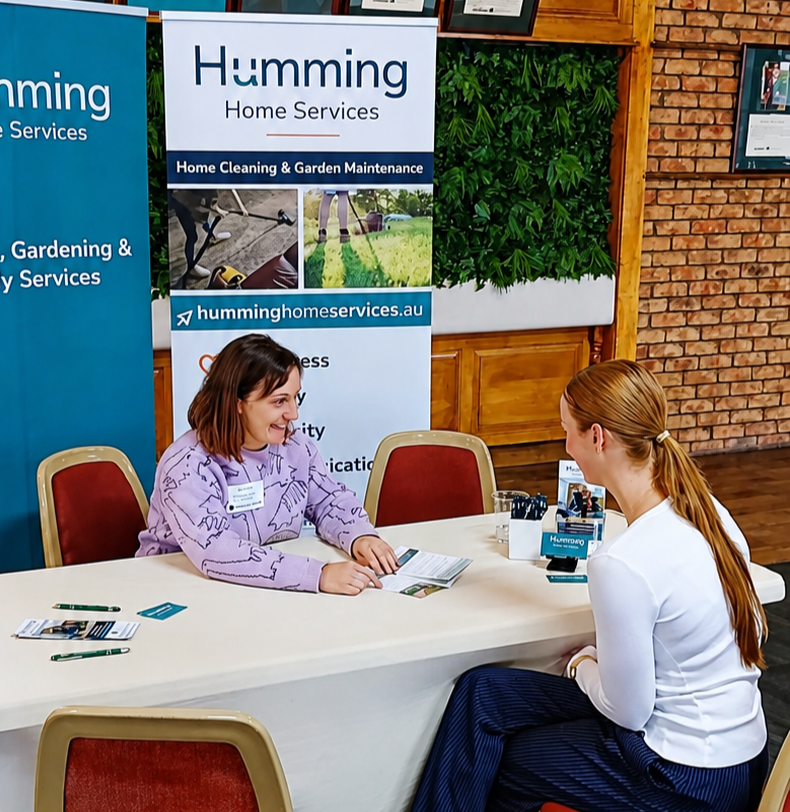
Connecting with the Community: Humming Home Services Hosts a Table at Kismet Events in Toowoomba & the Sunshine Coast

NDIS participant together with Humming home Services for Gardening and Home cleaning at Toowoomba, Sunshine Coast, Brisbane

Toowoomba | Sunshine Coast | Greater Brisbane
NDIS Registered Home Cleaning and Gardening Provider
Humminghomeservices.au

Last week, the Humming Home Services team had the privilege of hitting the road to participate in the Kismet Ready-Set-Connect events in both Toowoomba and the Sunshine Coast. We were thrilled to attend as an 

NDIS Registered Provider Table Host.

Getting out into the community and meeting face-to-face with the people who support NDIS participants is one of the most important things we do. Here is a recap of our experience and why building these local connections matters for the quality of care we provide.

What is a Kismet Ready-Set-Connect Event? 

A Kismet Ready-Set-Connect event is a signature speed-networking session designed to bring the local disability sector together. Providers like us act as “Table Hosts,” while NDIS participants, their families, and support coordinators rotate from table to table in a fast-paced, highly interactive environment to learn about local, verified services.

Hosting Care and Support Coordinators at Our Table 

For support coordinators, finding reliable, safe, and communicative service providers can be a significant challenge. At both the Toowoomba and Sunshine Coast events, we had the pleasure of welcoming dozens of dedicated care coordinators to our table to listen to their most pressing needs.

The recurring theme was clear: coordinators need providers who prioritize kindness, safety, integrity, and communication.

By hosting our table, we were able to demonstrate exactly how Humming Home Services operates. We shared our processes for ensuring our cleaning and gardening teams aren’t just completing tasks, but are actively contributing to a safe and comfortable home environment for NDIS participants.

Why Specialized NDIS Home Services Matter 

Maintaining a home shouldn’t be a source of stress. For NDIS participants, having a clean home and a well-maintained garden is fundamental to overall well-being and independence.

As Table Hosts, our attendance allowed us to showcase our core services directly to the people who coordinate care:

    • Home Cleaning: Thorough, respectful, and tailored to the unique needs of the participant.

    • Garden Maintenance: Keeping outdoor spaces safe, accessible, and beautiful.

    • Handy Services: Reliable help for the little things that keep a household running smoothly.

Looking Forward We left Toowoomba and the Sunshine Coast feeling incredibly inspired by the dedication of the local support coordinators who stopped by our setup. The relationships forged at these Kismet events will directly translate into faster, more reliable, and higher-quality home services for participants in these regions.

Frequently Asked Questions (FAQ)

Is Humming Home Services NDIS registered? 

Yes, Humming Home Services is a fully registered NDIS provider. We adhere to strict quality and safety standards to deliver home cleaning, gardening, and handy services to NDIS participants.

What areas does Humming Home Services service? 

We proudly offer our cleaning and gardening services across multiple regions, and are actively building our network in Toowoomba, Greater Brisbane area, and the Sunshine Coast.

Please contact our team or visit humminghomeservices.au to confirm availability in your specific suburb.

How can support coordinators refer a participant?

 Support coordinators can easily refer participants by visiting our website at humminghomeservices.au or contacting our support team directly via email: admin@humminghomeservices.auwww.gmail.com or mobile number: +61 478 534 064.

We prioritize clear communication to ensure seamless onboarding for your clients.

 Visit HummingHomeServices.au to learn more or make a referral.

I-Support-NDIS

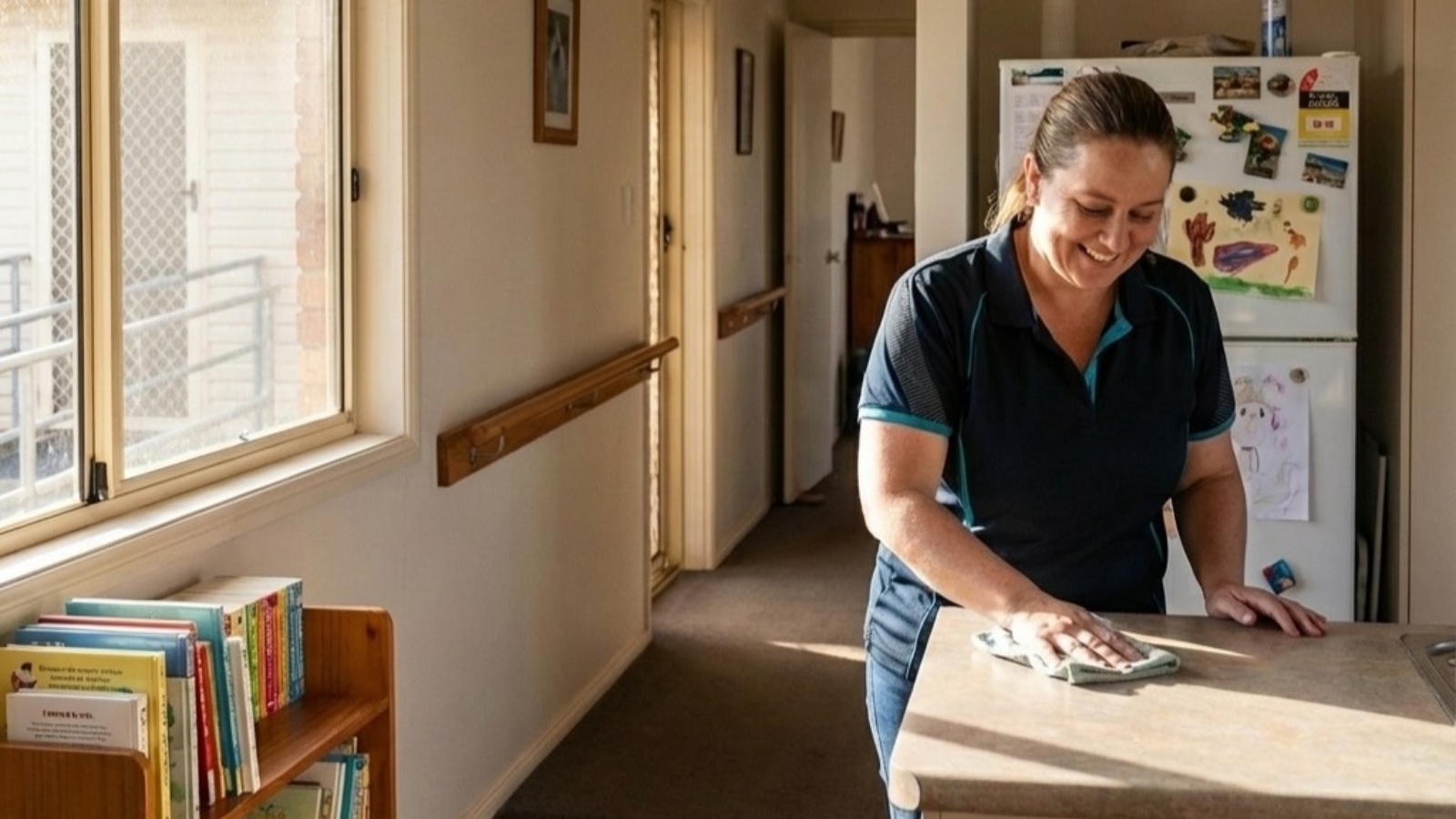
NDIS Cleaning Services Brisbane: Creating Safer,Healthier Homes for Independent Living

A Clean Home Makes Independent Living Easier

Living independently is about more than having a roof over your head. it’s

about enjoying a clean, safe, and comfortable environment that supports your
health and wellbeing.

For many Australians living with disability, everyday cleaning tasks can become
physically demanding or overwhelming. That’s where NDIS cleaning services in
Brisbane play an important role.

At Humming Home Services, we provide reliable, compassionate, and
professional cleaning solutions designed to help NDIS participants maintain a
healthy home while focusing on the things that matter most.

What Can NDIS Cleaning Include?

Depending on your NDIS plan and approved supports, our services may include:


    1. Vacuuming and mopping floors
    2. Kitchen cleaning and sanitising
    3. Bathroom cleaning
    4. Dusting furniture
    5. Changing bed linens
    6. Laundry assistance
    7. General home tidying
    8. Window cleaning
    9. Deep house cleaning
    10. Regular weekly or fortnightly cleaning
    11. Every service is tailored to meet individual needs and routines.

    More Than Just Cleaning

    A clean home reduces:

      • Allergens and dust
      • Slip and trip hazards
      • Germs and bacteria
      • Household stress
      • Professional home cleaning also promotes confidence, independence, and overall wellbeing.

      Professional home cleaning also promotes confidence, independence, and overall
      well-being.

      Our experienced team understands the unique needs of the NDIS community.

      We provide:


        • Friendly and respectful cleaners
        • Flexible scheduling
        • Reliable communication
        • Consistent quality
        • Personalised cleaning plans

        Whether you need weekly house cleaning in Brisbane, fortnightly cleaning services, or occasional deep cleaning, we’re here to help.

        Supporting Independence Every Day

        Our mission is simple:

        Helping people live comfortably in homes they love. If you’re looking for trusted NDIS home cleaning Brisbane services, we’d love to support your journey toward a cleaner, healthier lifestyle.

        Call Humming Home Services today for a personalised cleaning plan.


        image

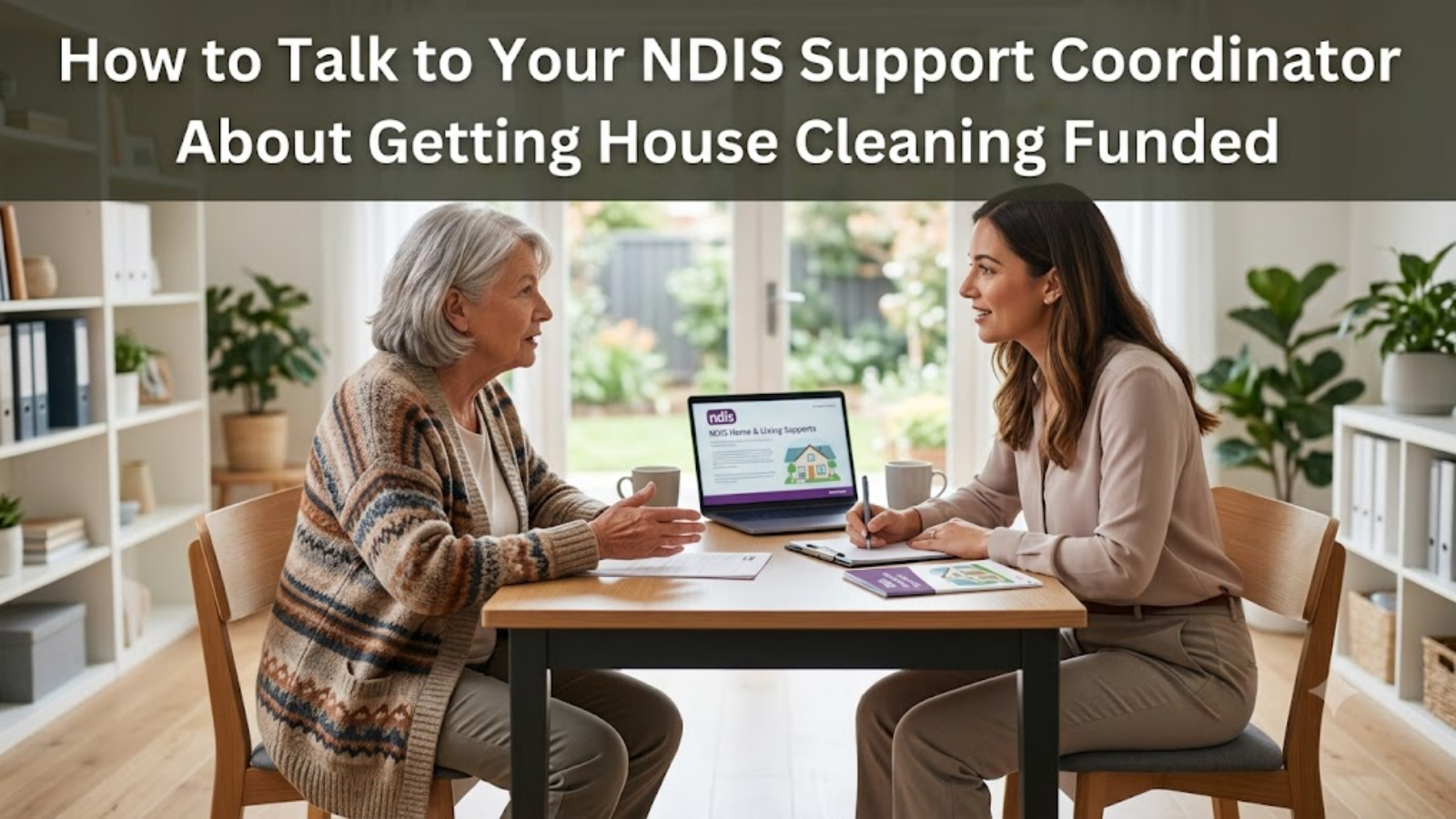
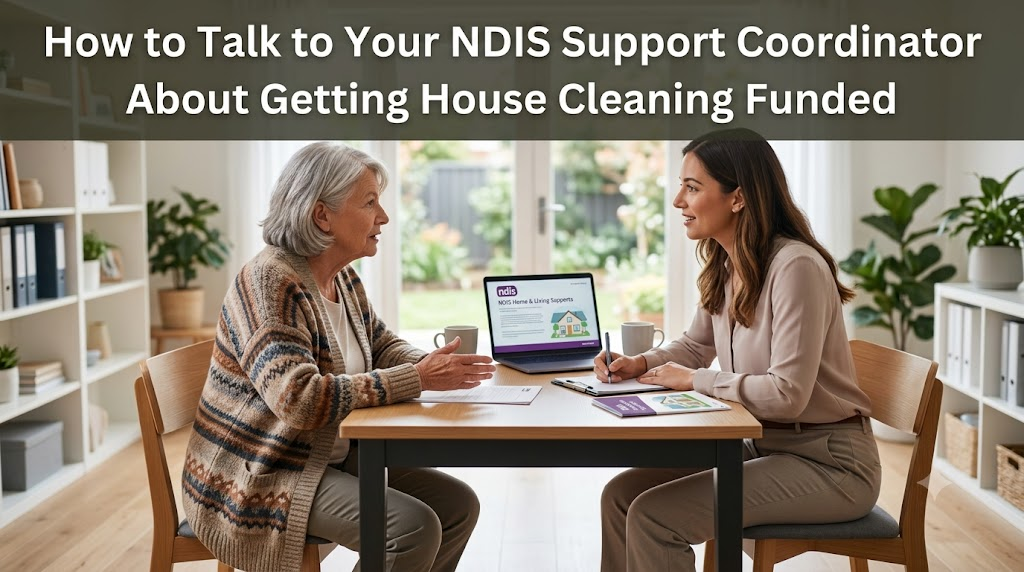
        How to Talk to Your NDIS Support Coordinator About Getting House Cleaning Funded

        📖 TLDR — 60 seconds Your NDIS “Assistance with Daily Life” budget explicitly funds household cleaning. Your SC wants you to ask — they’re measured on your goal attainment. Document your barriers, call your SC, link it to your plan goals, follow up in writing. Timeline: 4 weeks from conversation to first clean.

        → Want the full scripts and FAQ? Keep reading.

        How to Talk to Your NDIS Support Coordinator About Getting House Cleaning Funded

        The Conversation About NDIS Nobody Teaches You to Have

        I’m part of the team at Humming Home Services, and over the years working with hundreds of NDIS participants, I’ve learned this: the biggest barrier between people and funded cleaning services isn’t eligibility—it’s the conversation itself.

        Every week, I see posts on Reddit forums like r/NDIS and disability communities where people say things like:

        • "I'm scared my coordinator will think I'm asking for too much"
        • "Will they approve household cleaning? I've never asked before"
        • "I don't want to waste their time"

        Here’s the truth: Your Support Coordinator is there to help you use your NDIS funding for your needs.

        Asking for assistance with household tasks isn’t a luxury. It’s exactly what the “Assistance with Daily Life” category exists for.

        The problem isn’t your eligibility. It’s that most people approach this conversation unprepared, defensive, or apologetically. That changes today.


        Understanding Your NDIS Funding Category: Assistance with Daily Life

        Before you book that call with your SC, let’s clarify something that many people misunderstand.

        Your NDIS plan breaks down into support categories. One of them—“Assistance with Daily Life”—is explicitly designed to fund help with household tasks like:

        • Vacuuming, mopping, and floor cleaning
        • Bathroom and toilet sanitation
        • Kitchen cleaning (non-preparation)
        • Changing and washing bed linen
        • Laundry (washing, drying, folding)
        • General decluttering and organisation

        This isn’t a gray area. This isn’t you pushing boundaries. The NDIA literally created this category to fund exactly this service.

         If your disability makes it harder for you to safely or independently manage your household whether due to physical limitations, fatigue, cognitive challenges, or mental health barriers, then cleaning assistance fits within your allocated supports.

        Your Support Coordinator already knows this. The NDIS policy is clear. So why are so many people nervous?

        Because advocating for yourself feels hard. And that’s what we’re fixing here.


        Why Your Support Coordinator Wants You to Ask

        Here’s something I’ve learned after working with countless NDIS participants and their coordinators: They want participants to use their funding effectively.

        A good Support Coordinator is measured on outcomes. They succeed when:

        • Your goals are being met
        • Your quality of life improves
        • Your plan funding is spent efficiently
        • You’re not stressed or overwhelmed managing daily tasks
        • They can demonstrate participant satisfaction in reviews

        The incentive structure matters here. Support Coordinators are evaluated internally by their agencies (or by NDIS itself, if they’re NDIA-managed) on several metrics:

        1. Goal attainment — Are participants actually achieving what they set out to do in their plans?
        2. Participant satisfaction — How happy are participants with their coordinator and services?
        3. Efficient funding use — Is the plan budget being allocated strategically, not hoarded?
        4. Reduced crises — Do participants experience fewer emergency appointments, hospital visits, or plan adjustments due to preventable stress?

        When household overwhelm is blocking your employment goal or causing mental health crises, your SC knows this is a problem. And they know the solution. But they can’t implement it if you don’t ask.

        If untreated household management is stopping you from:

        • Attending appointments
        • Attending work or study
        • Engaging in community activities
        • Managing your physical or mental health
        • Maintaining relationships or social connection

        …then your SC should be recommending cleaning support. And if they’re not, you need to show them why.

        The coordinators I’ve worked with often say the same thing: “I wish more participants would tell me about these struggles. I can’t help solve problems I don’t know about. When someone comes to me with a clear barrier, I can usually find the budget. It’s the silence that kills outcomes.”

        Your SC isn’t a gatekeeper deciding if you “deserve” help. They’re a problem-solver trying to make your life work better within your plan. And frankly? A SC who helps you access household cleaning support looks good in their performance reviews because your goals improve.


        The 2 – Step Framework: How to Actually Have This Conversation

        Step 1: Prepare Your Documentation (Before the Call)

        You’ll want to have these ready when you speak to your SC:

        1. Identify the specific barriers

        Write down exactly how your disability impacts your ability to do household tasks. Be specific. Generic statements like “I find cleaning hard” won’t stick. Instead:

        • “I have chronic fatigue. After a 6-hour workday, I don’t have physical energy to vacuum safely. I’ve fallen twice trying to manage floors myself.”
        • “My anxiety is triggered by cluttered spaces. I intellectually know I should clean, but the overwhelm causes panic attacks that last hours.”
        • “I have a physical disability affecting my balance and grip strength. Mopping and scrubbing aggravate my chronic pain.”

        2. Connect it to your NDIS goals

        What are your plan goals? If one of them is “I want to work part-time” or “I want to maintain my independence and live safely at home”—then explain how household stress is blocking that.

        “My goal is to return to part-time work. Right now, I’m spending 8+ hours a week on household tasks when I should be using that time on job-seeking or resting to manage my fatigue. Professional cleaning would free up this capacity.”

        3. Have examples ready

        If you’ve missed appointments, work, or social activities because of household overwhelm—mention this. SCs live and breathe goal tracking. They understand that if household tasks are blocking your bigger goals, that’s a legitimate use of funding.

        Step 2: Choose the Right Communication Method & Script It

        Email, phone, or in-person meeting?

        Honestly? For this conversation, phone is better than email. Here’s why:

        • You can explain nuance in real-time
        • You can hear their response and adjust
        • It signals you take this seriously
        • There’s less chance of tone being misinterpreted

        Email is great for follow-up confirmation, but don’t start with it.


        Step 3 Get It in Writing

        After the call, follow up with an email summarizing:

        • What you discussed
        • What they agreed to
        • Next steps (do they need to get quotes? Will they add it to your plan?)

        “Thanks for the chat today. As we discussed, I’ll get quotes from registered cleaning agencies. Once I do, I’ll send them to you and we can update my plan to include X hours of household assistance per week. Does that work?”


        The Tricky Questions: Answered in Depth

        “What if my SC says no?”

        This is the question that keeps people up at night. Here’s what you need to know:

        A “no” should always come with a reason. If your SC refuses without explanation, that’s a red flag. Legitimate reasons might be:

        • “Your ‘Assistance with Daily Life’ budget is allocated to other supports, but we can request a plan review.” (This is fair—ask when)
        • “Let’s try [alternative solution] first and revisit at your next plan review.” (Also fair, but get a timeline)
        • “I need to speak with NDIA about your eligibility based on your functional capacity.” (Reasonable—offer to help with documentation)

        Illegitimate reasons that warrant escalation:

        • “We don’t fund cleaning.” (Wrong. NDIS literally does.)
        • “That’s not a disability need.” (Depends on your disability. If household management is impacted by your disability, it is.)
        • “You should ask family to help.” (Not their call. Your plan is yours to use.)

        If they say no with weak reasoning:

        Step 1: Ask why specifically, in writing. (“Can you clarify which barrier prevents this approval?”)

        Step 2: Request a plan review meeting. You have the right to challenge funding decisions.

        Step 3: If that fails, contact the NDIA Complaints Team. Not as a threat—as a process. Many SCs will reconsider when they realize you’re serious.

        Real talk: In my experience working with hundreds of NDIS participants, I’ve seen very few eligible participants get a hard “no” when they’re organized and clear. Most get “yes, but let’s do it this way” or “let’s revisit soon.”


        “Will asking for cleaning affect my other supports?”

        Short answer: No, not unless your SC is really bad.

        Longer answer: Your plan is divided into support categories with separate budgets. Here’s a simplified breakdown:

        • Assistance with Daily Life (cleaning, meal prep, etc.): Budget A
        • Disability-related Work & Disability Training: Budget B
        • Community, Social & Recreation: Budget C
        • etc.

        Adding cleaning to “Assistance with Daily Life” doesn’t reduce “Employment Supports” or “Social & Recreation.” They’re separate pools.

        However: If your overall plan funding is extremely limited and genuinely squeezed, your SC might need to make trade-offs. In that case, they’ll discuss this with you rather than just deciding. You get a say.

        If your SC tries to reduce other supports to fund cleaning without discussing it first, that’s poor practice. Push back.


        “Should I get quotes before asking?”

        Ideal answer: Yes, but not required.

        Getting 2-3 quotes before speaking to your SC shows you’ve done homework and removes vagueness. It also gives you confidence in what to ask for. Standard NDIS cleaning agencies charge between $50-59/hour (within NDIS pricing limits January 2026), so you can estimate:

        • 2 hours/week = ~$100-118/week = ~$400-475/month

        • 4 hours/week = ~$200-235/week = ~$800-950/month

        “Based on quotes I’ve received, professional cleaning for [X hours/week] costs about $[amount/month] within the NDIS pricing guidelines. Does my ‘Assistance with Daily Life’ budget allow for this?”

        This makes you sound informed and serious.

        If you don’t have quotes yet: Still ask. Say something like: “I’d like to explore this. Could we identify a budget range first, then I’ll get specific quotes?” Legitimate SCs will work with you either way.


        “Can I ask for more hours if I need them later?”

        Absolutely. Your plan can be adjusted between reviews if circumstances change. Here’s how it works:

        • Mid-plan request: You and your SC can request a plan review if needs genuinely change (injury, mental health crisis, new employment goal, etc.). NDIA can approve this.
        • At plan review: You definitely discuss increasing or decreasing hours. No problem.

        Real scenario: You start with 2 hours/week of cleaning. After 3 months, you return to work and realize you need 4 hours/week. Request a mid-plan review. This is normal and happens regularly.


        “What if I’m self-managed? Does this apply to me?”

        Yes, it applies differently but it applies.

        If you’re self-managed, you have even more flexibility:

        • You can hire anyone (registered or unregistered)
        • You directly manage the budget and invoices
        • You don’t need SC approval to use the support—you just need the budget allocated

        Your conversation: Still has the SC, but you’re basically saying: “I manage my own plan. I’d like ‘Assistance with Daily Life’ budget allocated to household support. I’ll handle provider selection and invoicing.”

        Actually easier than agency-managed in many ways.


        “My SC is new/hasn’t been with me long. Does that matter?”

        Not really. Here’s the thing: A new SC is often more receptive to exploring supports because:

        • They’re still learning your situation
        • They haven’t “locked in” previous patterns
        • They want to prove themselves helpful

        Your conversation is the same. If anything, being transparent with a new SC helps them understand you better from day one.


        “How long does approval actually take? Timeline question.”

        Real timeline (from experience):

        • Week 1: You have the conversation with SC
        • Week 2-3: You get quotes; SC may reach out to NDIA for clarification if needed (unlikely)
        • Week 3-4: Plan amendment drawn up and signed
        • Week 4-5: You contact cleaning provider; onboarding begins

        Total: 3-5 weeks from conversation to cleaning starting.

        Some SCs move faster. Some slower. Expect 4 weeks as a baseline.

        Key question to ask your SC: “Once we’ve agreed, how long until this is added to my plan and I can start booking services?” This sets a realistic expectation.


        Red Flags: When Your SC Isn’t Supporting You Properly

        You deserve a Support Coordinator who takes your needs seriously. Here are signs yours isn’t:

        🚩 They dismiss you without explanation“We don’t do cleaning” or “That’s not my job” (It is. And it’s theirs.)

        🚩 They’re consistently unreachable — Takes 2+ weeks to respond to calls/emails (Should be 3-5 business days)

        🚩 They guilt-trip you about spending“You have to justify every dollar” or “Why do you need this when you have family?” (Your plan. Your choice. Family help ≠ your supports.)

        🚩 They won’t document decisions — Refuses to put things in writing or confirm conversations in email (Major red flag. You need a paper trail.)

        🚩 They act surprised by your needs“Why didn’t you mention this before?” instead of “Let’s solve this together” (Not your fault they haven’t asked.)

        If you spot these patterns: Request a coordinator change. You can do this through your plan manager or directly with NDIA. It’s your right.

        A good SC is:

        • Responsive (replies within 3-5 business days)
        • Collaborative (problem-solves with you, not for you)
        • Proactive (asks about barriers, doesn’t wait to be told)
        • Willing to explore solutions within your budget
        • Clear about decisions, in writing

        If yours isn’t doing this, that’s a them problem, not a you problem.


        What Happens After Approval: Your Onboarding Checklist

        So your SC said yes. Great. Now what?

        Here’s the step-by-step of what typically happens next:

        Week 1: Plan Amendment
        Your SC drafts a plan amendment adding cleaning hours to your “Assistance with Daily Life” category. You’ll receive this for approval. Read it carefully. Make sure:

        • Hours are correct (e.g., “4 hours per week”)
        • Budget is allocated (should show ~$200-240/month if 4 hours/week)
        • It’s added to the right category

        Week 2: You Source a Provider
        Once amended, contact 2-3 registered NDIS cleaning providers and get formal quotes. Your SC may recommend someone, or you can search the NDIS Register.

        Things to ask a cleaning provider:

        • “Are you registered with NDIS?” (Must be yes)
        • “Do you bill direct to my plan?” (Should be yes)
        • “What’s your availability?” (Usually flexible)
        • “How do you communicate with my support coordinator?” (They should have a process)
        • “What happens if I need to reschedule?” (Should be reasonable—at least 24 hours notice)

        Week 3: Onboarding Call
        Provider will do a home visit or call to understand your space, preferences, any accessibility needs. This usually takes 30 minutes to 1 hour. Be honest about:

        • What areas are priority
        • Any mobility or sensory issues they should know about
        • Your preferred cleaning products (if you have sensitivities)
        • Whether you’ll be home during cleaning

        Week 4: First Clean
        You get your first professional clean. Take photos before/after if you want documentation for your records.


        The Final Piece: Confidence

        Here’s what I want you to know: You’re not asking for a favour. You’re using your own funding for a legitimate support need.

        Your Support Coordinator isn’t the NDIS police. They’re your advocate. They want you to succeed, live independently, and reach your goals.

        And if household overwhelm is in the way? Professional cleaning isn’t a luxury.

        It’s exactly what your plan exists to fund.


        Why Humming Home Services is Your Partner in This?

        Once your support coordinator approves household assistance, choosing the right provider matters deeply. At Humming Home Services, we understand the NDIS better than most because we work with it every day.

        Here’s what sets us apart:

        NDIS Registered — We’re fully compliant, registered, and approved to bill directly to your plan


        Disability-Informed — Our team understands disability, fatigue, sensory sensitivities, and accessibility needs. We’re not just cleaners, we’re trained to work with your specific barriers.


        Transparent Pricing — Our rates comply with NDIS Pricing Arrangements (within the $50-59/hour range), so you know exactly what your plan covers with no surprises.


        Reliable Communication — We communicate directly with your support coordinator, handle all invoicing compliantly, and provide the documentation they need.


        Flexible & Responsive — Need to reschedule? Change hours? We work with you, not against you.


        Genuine Care — We’re not processing you. We build relationships with every participant because we believe your home and your life matter.

        When you’re ready to move forward with a cleaning provider, we’d be honored to discuss how we can support your goals and free up your energy for the things that matter most.

        Ready to talk about your specific needs? Contact us for a free, no-obligation consultation. We’ll explain what we can do, answer all your questions, and work with you and your support coordinator to make the process smooth.


        Let’s help You NDIS Approved

        The hardest part is having the conversation with your SC. Once you do that, armed with the scripts, the examples, and the confidence that this is legitimate. The rest follows naturally.

        Your Support Coordinator is waiting to hear from you.

        And when you approve cleaning support, we’re here to deliver it with the reliability and respect you deserve.

        Have you had the cleaning conversation with your SC? Or are you preparing for it? We’d love to hear your story in the comments or reach out directly if you want to discuss your specific situation. We’re here to help.


        Contact Humming Home Services:


        • Let’s chat about your needs and how we can support your NDIS goals


        Cleaning Toowoomba ph

        What You Need To Know In Choosing Home Cleaning In Toowoomba, Greater Brisbane, and Sunshine Coast

        If you are searching for the best cleaning services for NDIS participants near you, you are not alone. Thousands of Australians living with disability rely on NDIS-funded domestic support, but finding a reliable, registered provider who genuinely gets your needs can feel like a lot of work. This guide walks you through exactly what to look for, and what separates a great provider from a disappointing one.

        Table of Contents
        1. Why NDIS-registered cleaning matters.
        2. What great NDIS cleaning services actually includ
        3. Plan-managed, self-managed and agency-managed: what is the difference?
        4. Five questions to ask before booking a cleaner
        5. What to look for in NDIS home cleaning near you
        6. How Humming supports NDIS participants across Queensland

        1. Why Choosing an NDIS-Registered Cleaning Provider Actually Matters

        Not every cleaning company can legally bill against your NDIS plan. If you are on an agency-managed or plan-managed plan, you need to work with a registered provider. Going with someone who is not registered could mean paying out of pocket, or your Support Coordinator spending hours trying to fix the mess afterward.

        But registration is not just a box-ticking exercise. Registered NDIS cleaning providers have gone through audits with the NDIS Quality and Safeguards Commission. They have had to prove that their workers are properly screened, that their insurance is in order, and that their services meet real quality standards. When someone is coming into your home, that kind of accountability matters a great deal.

        Worth knowing: “NDIS registered cleaner near me” is one of the most searched phrases by participants and their Support Coordinators. People searching that phrase are not browsing. They are ready to book.

        2. What Great NDIS Cleaning Services Actually Include

        The term NDIS cleaning services covers a wide range of things. Here is what a genuinely good provider should be bringing to the table.

        What You Should Expect as Standard

                Regular home cleaning that fits your support plan and your budget

                Scheduling that works around you, whether that is weekly, fortnightly, or something else entirely

                The same team members coming back each visit, so you are not constantly meeting someone new

                Cleaners who are respectful of your routines, your sensory preferences, and the way you like things done

                A clear, written service agreement that lines up with your NDIS funding categories

        What Sets the Better Providers Apart

        The best providers go beyond the cleaning itself. Yard maintenance, garden upkeep, and small handy jobs around the home can make a huge difference in day-to-day life, particularly for participants dealing with mobility issues or physical disability. When you can get all of that from one provider you trust, it removes a lot of unnecessary complexity from your life.


        “Everyone deserves to feel proud and inspired in their home, disability or not.”

        3. Plan-Managed, Self-Managed and Agency-Managed: Know the Difference

        A lot of people search for self-managed NDIS cleaning or plan-managed cleaning services NDIS because the three management types can be confusing. Here is a plain-language breakdown.

        Agency-Managed

        The NDIA pays your provider directly. You are required to use a registered provider. It is the most structured option and also the one that requires the least hands-on involvement from you.

        Plan-Managed

        A Plan Manager handles your funds and takes care of invoices on your behalf. You have more flexibility here because you can use registered or unregistered providers, though sticking with a registered one is generally the smarter call. Humming works with plan-managed participants regularly and is comfortable dealing directly with your Plan Manager when needed.

        Self-Managed

        You are in control of your own funds and can choose any provider you like. Even so, plenty of self-managed participants prefer to go with registered providers because of the quality assurance and worker screening that comes with the territory.

        A note for Support Coordinators: It is always worth asking whether a provider has experience working across all three management types. Those that do, like Humming, tend to be much easier to work with from an admin standpoint.

        4. Five Questions to Ask Before You Book an NDIS Cleaner

        Whether you are a participant doing your own research or a Support Coordinator vetting options for a client, these five questions will help you tell the good providers from the ones to avoid.

        1. Are you currently NDIS registered? Ask for their provider number and check it. Taking someone at their word is not enough.
        2. Do your workers hold valid NDIS Worker Screening Clearances? For participants with psychosocial or intellectual disabilities, this is not optional.
        3. Can you give me a written service agreement? Any solid provider will have one ready to go.
        4. How do you handle complaints or issues with service? Good providers have a clear process. Vague or defensive answers are a warning sign.

        Which specific areas do you service? A lot of providers claim broad coverage but have real gaps in availability. Ask about your suburb directly

        5. What to Look for in NDIS Home Cleaning Near You

        Searching best cleaning services for NDIS participants near me will bring up plenty of results. Here is how to cut through them quickly.

        Local Providers vs National Chains

        Large national cleaning companies often franchise their NDIS work out. The person showing up at the door may have very little training specific to disability support. Locally operated NDIS providers tend to be more personally accountable, more consistent with their team members, and generally easier to communicate with, for both participants and Support Coordinators.

        Communication Matters as Much as the Cleaning

        For participants on the autism spectrum, or those with anxiety or communication differences, how a provider handles communication is just as important as the quality of the clean itself. Look for providers who offer clear and simple communication, let you know what to expect before each visit, and make a real effort to keep the same team members coming to your home.

        Bundled Services Save Everyone Time

        If a participant needs both cleaning and NDIS gardening services, finding a single provider for both removes a lot of unnecessary admin. One agreement, one relationship, one invoice.

        6. How Humming Home Services Supports NDIS Participants Across Queensland

        Humming Home Services is an NDIS-registered provider operating across Greater Brisbane (including Ipswich, Logan, and Caboolture), the Sunshine Coast, and Toowoomba. We provide home cleaning and yard maintenance for participants on agency-managed, plan-managed, and self-managed plans.

        What we care about most is that every participant we support feels safe, respected, and genuinely comfortable in their own home. We put a lot of effort into consistent team matching, clear communication, and building service schedules that can flex as needs change over time.

        We also know that Support Coordinators and Plan Managers have a lot on their plates. We make it a point to communicate proactively, keep our documentation clean, and work within NDIS budgets without creating extra back-and-forth.

        Here is what working with Humming looks like:

        • NDIS-registered and open to agency-managed, plan-managed, and self-managed participants
        • Cleaning and gardening under one provider, with one agreement and one invoice
        • Consistent team members matched to each participant’s preferences and comfort
        • Proactive communication with Support Coordinators and Plan Managers
        • Servicing Greater Brisbane, Sunshine Coast, and Toowoomba

        Ready to Find the Right NDIS Cleaning Support?

        Whether you are a participant, a Support Coordinator, or a Plan Manager, we are happy to have a straightforward conversation about how Humming can help.

        Phone: 0478 534 064 Email: admin@humminghomeservices.au

        Website: humminghomeservices.au/contact