
📖 TLDR — 60 seconds Your NDIS “Assistance with Daily Life” budget explicitly funds household cleaning. Your SC wants you to ask — they’re measured on your goal attainment. Document your barriers, call your SC, link it to your plan goals, follow up in writing. Timeline: 4 weeks from conversation to first clean.
→ Want the full scripts and FAQ? Keep reading.
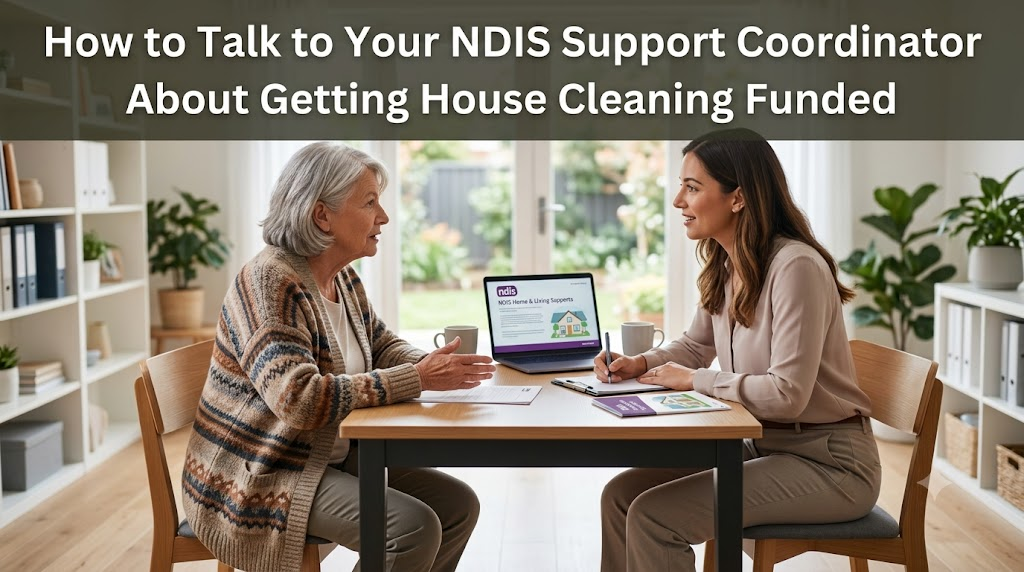
How to Talk to Your NDIS Support Coordinator About Getting House Cleaning Funded
The Conversation About NDIS Nobody Teaches You to Have
I’m part of the team at Humming Home Services, and over the years working with hundreds of NDIS participants, I’ve learned this: the biggest barrier between people and funded cleaning services isn’t eligibility—it’s the conversation itself.
Every week, I see posts on Reddit forums like r/NDIS and disability communities where people say things like:
-
"I'm scared my coordinator will think I'm asking for too much"
-
"Will they approve household cleaning? I've never asked before"
-
"I don't want to waste their time"
Here’s the truth: Your Support Coordinator is there to help you use your NDIS funding for your needs.
Asking for assistance with household tasks isn’t a luxury. It’s exactly what the “Assistance with Daily Life” category exists for.
The problem isn’t your eligibility. It’s that most people approach this conversation unprepared, defensive, or apologetically. That changes today.
Understanding Your NDIS Funding Category: Assistance with Daily Life
Before you book that call with your SC, let’s clarify something that many people misunderstand.
Your NDIS plan breaks down into support categories. One of them—“Assistance with Daily Life”—is explicitly designed to fund help with household tasks like:
- Vacuuming, mopping, and floor cleaning
- Bathroom and toilet sanitation
- Kitchen cleaning (non-preparation)
- Changing and washing bed linen
- Laundry (washing, drying, folding)
- General decluttering and organisation
This isn’t a gray area. This isn’t you pushing boundaries. The NDIA literally created this category to fund exactly this service.
If your disability makes it harder for you to safely or independently manage your household whether due to physical limitations, fatigue, cognitive challenges, or mental health barriers, then cleaning assistance fits within your allocated supports.
Your Support Coordinator already knows this. The NDIS policy is clear. So why are so many people nervous?
Because advocating for yourself feels hard. And that’s what we’re fixing here.
Why Your Support Coordinator Wants You to Ask
Here’s something I’ve learned after working with countless NDIS participants and their coordinators: They want participants to use their funding effectively.
A good Support Coordinator is measured on outcomes. They succeed when:
- Your goals are being met
- Your quality of life improves
- Your plan funding is spent efficiently
- You’re not stressed or overwhelmed managing daily tasks
- They can demonstrate participant satisfaction in reviews
The incentive structure matters here. Support Coordinators are evaluated internally by their agencies (or by NDIS itself, if they’re NDIA-managed) on several metrics:
- Goal attainment — Are participants actually achieving what they set out to do in their plans?
- Participant satisfaction — How happy are participants with their coordinator and services?
- Efficient funding use — Is the plan budget being allocated strategically, not hoarded?
- Reduced crises — Do participants experience fewer emergency appointments, hospital visits, or plan adjustments due to preventable stress?
When household overwhelm is blocking your employment goal or causing mental health crises, your SC knows this is a problem. And they know the solution. But they can’t implement it if you don’t ask.
If untreated household management is stopping you from:
- Attending appointments
- Attending work or study
- Engaging in community activities
- Managing your physical or mental health
- Maintaining relationships or social connection
…then your SC should be recommending cleaning support. And if they’re not, you need to show them why.
The coordinators I’ve worked with often say the same thing: “I wish more participants would tell me about these struggles. I can’t help solve problems I don’t know about. When someone comes to me with a clear barrier, I can usually find the budget. It’s the silence that kills outcomes.”
Your SC isn’t a gatekeeper deciding if you “deserve” help. They’re a problem-solver trying to make your life work better within your plan. And frankly? A SC who helps you access household cleaning support looks good in their performance reviews because your goals improve.
The 2 – Step Framework: How to Actually Have This Conversation
Step 1: Prepare Your Documentation (Before the Call)
You’ll want to have these ready when you speak to your SC:
1. Identify the specific barriers
Write down exactly how your disability impacts your ability to do household tasks. Be specific. Generic statements like “I find cleaning hard” won’t stick. Instead:
- “I have chronic fatigue. After a 6-hour workday, I don’t have physical energy to vacuum safely. I’ve fallen twice trying to manage floors myself.”
- “My anxiety is triggered by cluttered spaces. I intellectually know I should clean, but the overwhelm causes panic attacks that last hours.”
- “I have a physical disability affecting my balance and grip strength. Mopping and scrubbing aggravate my chronic pain.”
2. Connect it to your NDIS goals
What are your plan goals? If one of them is “I want to work part-time” or “I want to maintain my independence and live safely at home”—then explain how household stress is blocking that.
“My goal is to return to part-time work. Right now, I’m spending 8+ hours a week on household tasks when I should be using that time on job-seeking or resting to manage my fatigue. Professional cleaning would free up this capacity.”
3. Have examples ready
If you’ve missed appointments, work, or social activities because of household overwhelm—mention this. SCs live and breathe goal tracking. They understand that if household tasks are blocking your bigger goals, that’s a legitimate use of funding.
Step 2: Choose the Right Communication Method & Script It
Email, phone, or in-person meeting?
Honestly? For this conversation, phone is better than email. Here’s why:
- You can explain nuance in real-time
- You can hear their response and adjust
- It signals you take this seriously
- There’s less chance of tone being misinterpreted
Email is great for follow-up confirmation, but don’t start with it.
Step 3 Get It in Writing
After the call, follow up with an email summarizing:
- What you discussed
- What they agreed to
- Next steps (do they need to get quotes? Will they add it to your plan?)
“Thanks for the chat today. As we discussed, I’ll get quotes from registered cleaning agencies. Once I do, I’ll send them to you and we can update my plan to include X hours of household assistance per week. Does that work?”
The Tricky Questions: Answered in Depth
“What if my SC says no?”
This is the question that keeps people up at night. Here’s what you need to know:
A “no” should always come with a reason. If your SC refuses without explanation, that’s a red flag. Legitimate reasons might be:
- “Your ‘Assistance with Daily Life’ budget is allocated to other supports, but we can request a plan review.” (This is fair—ask when)
- “Let’s try [alternative solution] first and revisit at your next plan review.” (Also fair, but get a timeline)
- “I need to speak with NDIA about your eligibility based on your functional capacity.” (Reasonable—offer to help with documentation)
Illegitimate reasons that warrant escalation:
- “We don’t fund cleaning.” (Wrong. NDIS literally does.)
- “That’s not a disability need.” (Depends on your disability. If household management is impacted by your disability, it is.)
- “You should ask family to help.” (Not their call. Your plan is yours to use.)
If they say no with weak reasoning:
Step 1: Ask why specifically, in writing. (“Can you clarify which barrier prevents this approval?”)
Step 2: Request a plan review meeting. You have the right to challenge funding decisions.
Step 3: If that fails, contact the NDIA Complaints Team. Not as a threat—as a process. Many SCs will reconsider when they realize you’re serious.
Real talk: In my experience working with hundreds of NDIS participants, I’ve seen very few eligible participants get a hard “no” when they’re organized and clear. Most get “yes, but let’s do it this way” or “let’s revisit soon.”
“Will asking for cleaning affect my other supports?”
Short answer: No, not unless your SC is really bad.
Longer answer: Your plan is divided into support categories with separate budgets. Here’s a simplified breakdown:
- Assistance with Daily Life (cleaning, meal prep, etc.): Budget A
- Disability-related Work & Disability Training: Budget B
- Community, Social & Recreation: Budget C
- etc.
Adding cleaning to “Assistance with Daily Life” doesn’t reduce “Employment Supports” or “Social & Recreation.” They’re separate pools.
However: If your overall plan funding is extremely limited and genuinely squeezed, your SC might need to make trade-offs. In that case, they’ll discuss this with you rather than just deciding. You get a say.
If your SC tries to reduce other supports to fund cleaning without discussing it first, that’s poor practice. Push back.
“Should I get quotes before asking?”
Ideal answer: Yes, but not required.
Getting 2-3 quotes before speaking to your SC shows you’ve done homework and removes vagueness. It also gives you confidence in what to ask for. Standard NDIS cleaning agencies charge between $50-59/hour (within NDIS pricing limits January 2026), so you can estimate:
-
2 hours/week = ~$100-118/week = ~$400-475/month
-
4 hours/week = ~$200-235/week = ~$800-950/month
“Based on quotes I’ve received, professional cleaning for [X hours/week] costs about $[amount/month] within the NDIS pricing guidelines. Does my ‘Assistance with Daily Life’ budget allow for this?”
This makes you sound informed and serious.
If you don’t have quotes yet: Still ask. Say something like: “I’d like to explore this. Could we identify a budget range first, then I’ll get specific quotes?” Legitimate SCs will work with you either way.
“Can I ask for more hours if I need them later?”
Absolutely. Your plan can be adjusted between reviews if circumstances change. Here’s how it works:
- Mid-plan request: You and your SC can request a plan review if needs genuinely change (injury, mental health crisis, new employment goal, etc.). NDIA can approve this.
- At plan review: You definitely discuss increasing or decreasing hours. No problem.
Real scenario: You start with 2 hours/week of cleaning. After 3 months, you return to work and realize you need 4 hours/week. Request a mid-plan review. This is normal and happens regularly.
“What if I’m self-managed? Does this apply to me?”
Yes, it applies differently but it applies.
If you’re self-managed, you have even more flexibility:
- You can hire anyone (registered or unregistered)
- You directly manage the budget and invoices
- You don’t need SC approval to use the support—you just need the budget allocated
Your conversation: Still has the SC, but you’re basically saying: “I manage my own plan. I’d like ‘Assistance with Daily Life’ budget allocated to household support. I’ll handle provider selection and invoicing.”
Actually easier than agency-managed in many ways.
“My SC is new/hasn’t been with me long. Does that matter?”
Not really. Here’s the thing: A new SC is often more receptive to exploring supports because:
- They’re still learning your situation
- They haven’t “locked in” previous patterns
- They want to prove themselves helpful
Your conversation is the same. If anything, being transparent with a new SC helps them understand you better from day one.
“How long does approval actually take? Timeline question.”
Real timeline (from experience):
- Week 1: You have the conversation with SC
- Week 2-3: You get quotes; SC may reach out to NDIA for clarification if needed (unlikely)
- Week 3-4: Plan amendment drawn up and signed
- Week 4-5: You contact cleaning provider; onboarding begins
Total: 3-5 weeks from conversation to cleaning starting.
Some SCs move faster. Some slower. Expect 4 weeks as a baseline.
Key question to ask your SC: “Once we’ve agreed, how long until this is added to my plan and I can start booking services?” This sets a realistic expectation.
Red Flags: When Your SC Isn’t Supporting You Properly
You deserve a Support Coordinator who takes your needs seriously. Here are signs yours isn’t:
🚩 They dismiss you without explanation — “We don’t do cleaning” or “That’s not my job” (It is. And it’s theirs.)
🚩 They’re consistently unreachable — Takes 2+ weeks to respond to calls/emails (Should be 3-5 business days)
🚩 They guilt-trip you about spending — “You have to justify every dollar” or “Why do you need this when you have family?” (Your plan. Your choice. Family help ≠ your supports.)
🚩 They won’t document decisions — Refuses to put things in writing or confirm conversations in email (Major red flag. You need a paper trail.)
🚩 They act surprised by your needs — “Why didn’t you mention this before?” instead of “Let’s solve this together” (Not your fault they haven’t asked.)
If you spot these patterns: Request a coordinator change. You can do this through your plan manager or directly with NDIA. It’s your right.
A good SC is:
- Responsive (replies within 3-5 business days)
- Collaborative (problem-solves with you, not for you)
- Proactive (asks about barriers, doesn’t wait to be told)
- Willing to explore solutions within your budget
- Clear about decisions, in writing
If yours isn’t doing this, that’s a them problem, not a you problem.
What Happens After Approval: Your Onboarding Checklist
So your SC said yes. Great. Now what?
Here’s the step-by-step of what typically happens next:
Week 1: Plan Amendment
Your SC drafts a plan amendment adding cleaning hours to your “Assistance with Daily Life” category. You’ll receive this for approval. Read it carefully. Make sure:
- Hours are correct (e.g., “4 hours per week”)
- Budget is allocated (should show ~$200-240/month if 4 hours/week)
- It’s added to the right category
Week 2: You Source a Provider
Once amended, contact 2-3 registered NDIS cleaning providers and get formal quotes. Your SC may recommend someone, or you can search the NDIS Register.
Things to ask a cleaning provider:
- “Are you registered with NDIS?” (Must be yes)
- “Do you bill direct to my plan?” (Should be yes)
- “What’s your availability?” (Usually flexible)
- “How do you communicate with my support coordinator?” (They should have a process)
- “What happens if I need to reschedule?” (Should be reasonable—at least 24 hours notice)
Week 3: Onboarding Call
Provider will do a home visit or call to understand your space, preferences, any accessibility needs. This usually takes 30 minutes to 1 hour. Be honest about:
- What areas are priority
- Any mobility or sensory issues they should know about
- Your preferred cleaning products (if you have sensitivities)
- Whether you’ll be home during cleaning
Week 4: First Clean
You get your first professional clean. Take photos before/after if you want documentation for your records.
The Final Piece: Confidence
Here’s what I want you to know: You’re not asking for a favour. You’re using your own funding for a legitimate support need.
Your Support Coordinator isn’t the NDIS police. They’re your advocate. They want you to succeed, live independently, and reach your goals.
And if household overwhelm is in the way? Professional cleaning isn’t a luxury.
It’s exactly what your plan exists to fund.
Why Humming Home Services is Your Partner in This?
Once your support coordinator approves household assistance, choosing the right provider matters deeply. At Humming Home Services, we understand the NDIS better than most because we work with it every day.
Here’s what sets us apart:
✓ NDIS Registered — We’re fully compliant, registered, and approved to bill directly to your plan
✓ Disability-Informed — Our team understands disability, fatigue, sensory sensitivities, and accessibility needs. We’re not just cleaners, we’re trained to work with your specific barriers.
✓ Transparent Pricing — Our rates comply with NDIS Pricing Arrangements (within the $50-59/hour range), so you know exactly what your plan covers with no surprises.
✓ Reliable Communication — We communicate directly with your support coordinator, handle all invoicing compliantly, and provide the documentation they need.
✓ Flexible & Responsive — Need to reschedule? Change hours? We work with you, not against you.
✓ Genuine Care — We’re not processing you. We build relationships with every participant because we believe your home and your life matter.
When you’re ready to move forward with a cleaning provider, we’d be honored to discuss how we can support your goals and free up your energy for the things that matter most.
Ready to talk about your specific needs? Contact us for a free, no-obligation consultation. We’ll explain what we can do, answer all your questions, and work with you and your support coordinator to make the process smooth.
Let’s help You NDIS Approved
The hardest part is having the conversation with your SC. Once you do that, armed with the scripts, the examples, and the confidence that this is legitimate. The rest follows naturally.
Your Support Coordinator is waiting to hear from you.
And when you approve cleaning support, we’re here to deliver it with the reliability and respect you deserve.
Have you had the cleaning conversation with your SC? Or are you preparing for it? We’d love to hear your story in the comments or reach out directly if you want to discuss your specific situation. We’re here to help.
Contact Humming Home Services:
- Book an Appointment with us so we can guide you Step by Step: https://humminghomeservices.au/work-with-us/
- Let’s chat about your needs and how we can support your NDIS goals